A sudden jolt at a traffic light often feels worse than it looks. Modern bumper covers, molded from flexible thermoplastic olefin, pop back into shape seconds after an impact. A motorist might step out into the street, inspect the rear bumper, and observe nothing more than surface paint abrasions or faint hairline scratches in the clear coat. That brief visual inspection frequently creates an unfounded sense of relief. Beneath that smooth plastic shell sits an intricate structure of crush boxes, steel crossmembers, and calibrated sensor mounts engineered to absorb kinetic energy.
When a rear-end collision occurs, physics dictates that kinetic energy never vanishes on its own. If the flexible plastic cover does not crush, that force travels directly inward toward the core structural platform of the automobile. The presence of an aftermarket or factory-installed hitch makes this mechanical dynamic significantly more unpredictable. Instead of allowing the bumper reinforcement bar and energy-absorbing foam to cushion the blow, a rigid steel receiver transfers the full weight of the striking vehicle straight into the mounting plates of the chassis.
Drivers frequently assume that if a vehicle drives away without stalling, no meaningful harm occurred. This assumption regularly leads to costly surprises down the line. What initially seems like an unnecessary car repair appointment often reveals deep structural trauma that compromises passenger safety and accelerates mechanical wear across unrelated assemblies.
Kinetic Energy Pathways and Towing Hardware
Automotive engineers design passenger cars and light trucks with crumple zones engineered to fold progressively during a wreck. These zones sacrifice outer sheet metal to absorb deceleration forces before shockwaves penetrate the passenger cabin. A receiver tube, however, completely alters that safety equation. Bolted or welded directly to the frame rails, towing hardware sits lower and further back than standard bumper reinforcement beams.
When a trailing car strikes that protruding steel tongue, it strikes an unyielding, solid object. The impact bypasses the sacrificial crush boxes and honeycombed polystyrene absorbers designed to protect the platform. Instead of dissipating horizontally across the rear apron, energy concentrates into a single focal point. The mounting brackets act as rigid levers, twisting the rear frame horns downward while pitching the middle section of the platform upward.
Even heavy-duty pickup trucks with fully boxed steel frames suffer under these concentrated loads. The force can bend the trailer receiver, distort the rear axle hanger mounts, and deform structural crossmembers beneath the cargo bed. Replacing damaged towing assemblies requires certified, crash-tested auto parts rather than bent hardware straightened on an anvil. Reusing an impacted receiver assembly invites catastrophic failure the next time an owner attempts to pull a heavy trailer down the highway.
Structural Frame Twisting and Unibody Misalignment
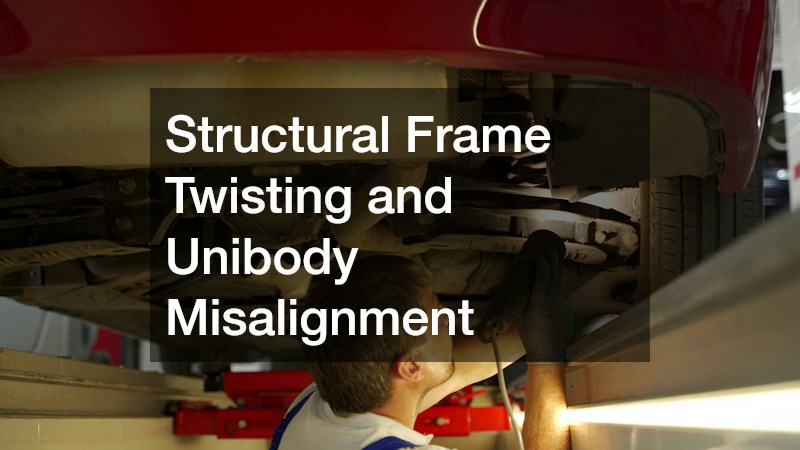
Unibody construction dominates the modern automotive market. Unlike older vehicles built on heavy perimeter frames, unibody cars, crossovers, and compact pickup trucks integrate the cabin, roof, and floor pans into a single cohesive steel or aluminum structure. When rear-end collision energy travels through this unified shell, deformation rarely stops at the rear bumper bar.
The kinetic shock wave ripples across the rear floor pan, buckling the spare tire well and pinching structural seams. One common sign of latent structural trauma involves misaligned closure panels. If a trunk lid catches against the latch, a tailgate requires extra muscle to shut, or rear doors rub against the center pillars, the unibody has experienced torsional twist. In severe instances, the rear quarter panels buckle, creating subtle waves in the sheet metal above the rear wheel wells that become visible only under angled shop lighting.
Tolerances on modern automotive platforms are measured down to the individual millimeter. Even three millimeters of structural racking alters the factory crash structure, rendering the vehicle less capable of managing secondary impacts. Identifying these shifts requires specialized digital measuring systems that compare three-dimensional target points against factory computer models. Booking an evaluation with a local car collision repair facility ensures that technicians mount the chassis onto a dedicated pulling bench to measure whether the vehicle remains square, plumb, and safe for highway travel.
Drivetrain Trauma: Shockwaves Reaching the Transmission
One of the most insidious consequences of a rear impact involves mechanical shock traveling forward through the vehicle drivetrain. This issue poses an especially high threat to rear-wheel-drive, all-wheel-drive, and four-wheel-drive platforms where the rear axle assembly connects directly to the forward powertrain via a steel or aluminum driveshaft.
When a striking vehicle impacts the rear axle, differential housing, or structural members adjacent to the suspension, kinetic force can shove the entire rear axle assembly forward along its control arms. The rotating driveshaft compresses against its slip yoke, turning into a solid metal ram. That kinetic energy travels up the propeller shaft and punches directly into the transmission output shaft and the transfer case.
Internal transmission components do not tolerate high longitudinal impact loads. The blunt forward thrust can crack the aluminum bellhousing, shatter internal thrust bearings, fracture planet carrier assemblies, or bend the output shaft itself. Symptoms often develop gradually over several days of ordinary commuting. Drivers might observe fluid puddles beneath the tailshaft, experience harsh gear engagement, hear high-pitched whines during highway cruising, or notice sudden hesitation between gears. Seeking immediate transmission repair prevents these internal metal fractures from circulating fine shavings throughout the valve body, saving the owner from a total mechanical rebuild.
Roof Rail Flex and Windshield Integrity
Few motorists realize that the front windshield of an automobile serves as a vital structural brace for the entire passenger compartment. Modern automotive engineering relies on high-modulus urethane adhesives to bond the laminated safety glass directly into the windshield pinch weld. This integration provides up to thirty percent of the structural rigidity of the cabin during a rollover and keeps the front roof pillars rigid during catastrophic impacts.
When an automobile gets slammed from behind, the upward buckling of the rear floor pan forces torsional waves along the roof rails and down through the windshield pillars. This twisting motion puts the glass under tremendous shear stress. A motorist might walk away from a crash with an intact bumper cover, only to find a mysterious creeping stress fracture originating from the lower edge of the front windshield several days later.
In other scenarios, the impact breaks the chemical bond between the glass and the vehicle frame without cracking the laminated panel itself. This hidden failure allows water leaks, generates wind noise at highway speeds, and dangerously compromises passenger airbag deployment. Completing a certified auto windshield replacement restores cabin integrity while ensuring that forward-facing safety cameras receive proper optical clearance and recalibration.
Electronic Sensor Arrays and Calibration Requirements
Today’s vehicles rely heavily on complex safety electronics tucked neatly behind the rear body panels. Blind-spot monitoring radars, rear cross-traffic sensors, park-assist ultrasonic transducers, and digital backup cameras inhabit the space directly behind the rear fascia. When an impact jars this area, the brittle plastic brackets holding these sensors in place frequently snap or twist out of factory tolerance.
A driver might never receive a warning light on the instrument cluster even after severe bracket deformation. A radar sensor deflected by merely one or two degrees can mistakenly aim its beam toward passing highway guardrails or miss an oncoming vehicle in an adjacent blind spot altogether. Furthermore, collision shock can pinch underlying wiring harnesses against sharp edge metal, causing intermittent short circuits that corrupt vehicle data networks months after the event.
Diagnosing these complex electronic discrepancies requires far more than plugging in a generic handheld code scanner. Advanced driver assistance systems demand controlled lighting, level floors, and laser targeting boards to aim millimeter-wave sensors back to factory specifications. When sophisticated electronic arrays or specialized luxury systems sustain shock damage, entrusting the diagnostics to a shop focused on specialty auto repair guarantees that safety features respond correctly when road hazards suddenly appear.
Facility Selection: Dealerships Versus Independent Centers

Following a rear collision, vehicle owners must decide where to direct their transportation for a reliable assessment. Many motorists instinctively head straight to their regional auto dealer, believing that the original seller provides the only dependable environment for comprehensive collision evaluation. Franchised dealerships certainly offer direct access to proprietary factory software, original service bulletins, and certified powertrain mechanics who know brand-specific engineering intricacies.
However, many vehicle owners are surprised to learn that a large percentage of dealerships subcontract heavy bodywork and structural frame pulling to third-party collision facilities. In many communities, an independent local auto body shop equipped with high-tonnage unibody benches, computerized laser measuring systems, and certified downdraft paint booths delivers more focused structural expertise than a general retail service bay.
The primary consideration when choosing a repair provider should center around equipment, methodology, and technical certifications rather than the sign hanging out front. Discerning motorists should seek out facilities holding I-CAR Gold Class recognition or official manufacturer collision certifications. Qualified technicians at these dedicated centers follow rigid blueprinting procedures that systematically disassemble damaged components, measure bare unibody mounting points, and produce comprehensive digital documentation before any metal cutting or panel replacement begins.
The Teardown Phase and Uncovering Hidden Estimates
Insurance adjusters frequently write preliminary estimates based on visual walkarounds conducted in parking lots or residential driveways. These preliminary calculations almost always understate the true scope of damage because plastic bumpers hide the buckled sheet metal beneath. True discovery occurs only during a complete structural teardown at an authorized repair facility.
During a professional teardown, technicians remove the bumper cover, energy absorber, tail lamps, and trunk lining to inspect bare metal. This process exposes warped frame rails, torn pinch welds, split seam sealer, and micro-cracks in mounting points. When structural damage is documented with digital photographs and electronic measurements, the shop submits a supplement to the insurance carrier. Relying on an established local car collision repair center ensures that technicians demand adequate labor hours and proper materials rather than accepting superficial patches that leave structural weak points unaddressed.
A critical element of this teardown phase involves auditing the components specified by the insurance company. Adjusters often attempt to cut claim costs by mandating salvage, reconditioned, or low-cost imitation items. To preserve crash-test integrity, vehicle owners have the legal right to insist on original equipment manufacturer auto parts that match factory metallurgy and tensile strength. Verifying every line item during teardown prevents subpar components from compromising the long-term safety of the automobile.
Legal Protection and Documenting Latent Vehicle Damage

When a rear-end collision causes extensive hidden structural or mechanical harm, insurance companies frequently push back against supplemental repair claims. Adjusters may assert that a bent frame horn, cracked drivetrain housing, or shattered sensor bracket was pre-existing wear rather than damage caused by the collision. This resistance leaves vehicle owners facing thousands of dollars in unpaid repair bills or stranded with a car that cannot safely pass a state safety inspection.
In situations involving severe frame displacement, disputed mechanical failure, or personal injury, consulting an experienced car accident attorney provides vital legal protection. A qualified legal professional coordinates with accident reconstruction specialists and master mechanics to establish a clear chain of causation between the impact and the latent mechanical failures. They also hold insurance carriers accountable to policy terms, preventing bad-faith claim denials and aggressive lowball settlement offers.
Beyond direct repair costs, legal representation plays an essential role in recovering diminished value. Even after flawless structural restoration, a vehicle with an accident history on public vehicle history reports loses between ten and thirty percent of its fair market value. A legal representative ensures that the liable party’s insurer compensates the owner for this financial loss, shielding the motorist from absorbing an unfair financial hit when trading the vehicle in the future.
Restoring Pre-Loss Safety and Protecting Resale Equity
Restoring a vehicle after a severe rear collision requires diligence, technical precision, and an uncompromising commitment to passenger safety. Overlooking hidden frame twists, damaged drivetrain components, or distorted chassis mounts turns an otherwise reliable automobile into a persistent hazard on the road. Motorists must treat every rear-end collision as a potential structural event, regardless of how minor the exterior plastic scuffs appear on the surface.
Before returning a repaired truck or sport utility vehicle to service, owners must pay close attention to auxiliary towing assemblies. If the vehicle was struck while carrying a ball mount, technicians must inspect the mounting points on the frame and install a completely new hitch rather than attempting to straighten the old assembly. A compromised towing receiver can shear under load, sending a runaway trailer into highway traffic.
Ultimately, successful post-collision recovery relies on thorough inspection, certified technical execution, and comprehensive documentation. Motorists should never rush through the insurance claims process or accept the lowest preliminary estimate just to get their vehicle back quickly. Demanding a comprehensive diagnostic scan, insisting on certified structural alignment, and refusing corner-cutting car repair practices ensures that the vehicle retains its structural integrity, resale value, and ability to protect its occupants for years to come.
